- Home
- Case studies
- Supplements
A supplement store relaunch, then SEO and AI visibility
A store moving from lifestyle accessories to 58 supplements was rebuilt in the days before launch. After launch, its pages were made readable to search engines and AI assistants, with a measured before and after for every change.
- Client
- Supplement brand
- Market
- United States
- Platform
- Shopify
- Role
- Hafiz Fahad Munir, sole developer
- When
- 27 August to 18 September 2026
- Status
- Live.
Background
The owner was turning a lifestyle accessories store into a supplement brand, with 58 products and a launch a few days away. The job came through Upwork as a store rebuild.
The challenge
Before launch, the new categories were empty, the copy still described the old products, Add to Cart on product cards only appeared on hover, and one product button was black on black.
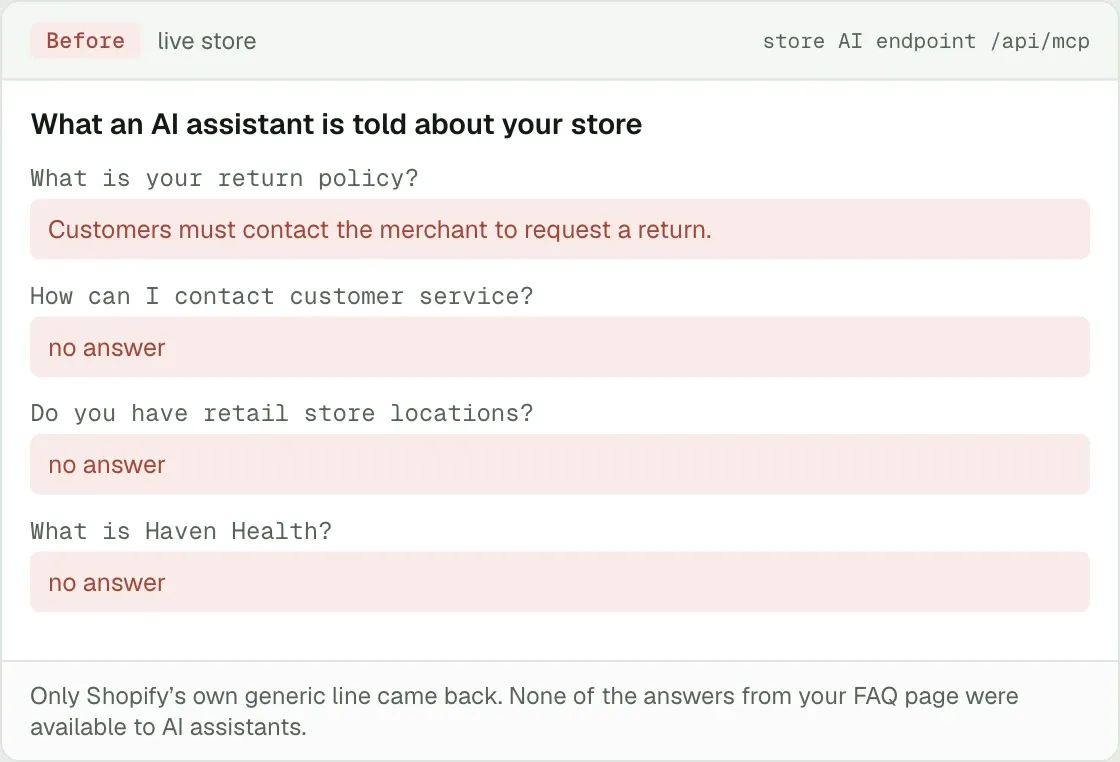
After launch, search engines and AI assistants had very little to read. Collection pages had no real main heading, product data was in an older format with relative links, and when an AI assistant asked the store about returns, customer service or locations, it got no answer at all.
What was built
Before launch
- Four new categories covering all 58 products.
- A rebuilt hero, FAQ and About page, a copy sweep across the whole site, and unused apps cleaned up.
- The root causes behind the bugs: the hover-only Add to Cart, the black on black button and blurry product photos on phones.
After launch: SEO and AI visibility
- A real main heading on every collection page.
- Structured data for the brand, every product, breadcrumbs and the FAQ, and noindex on thin pages that should not be in Google.
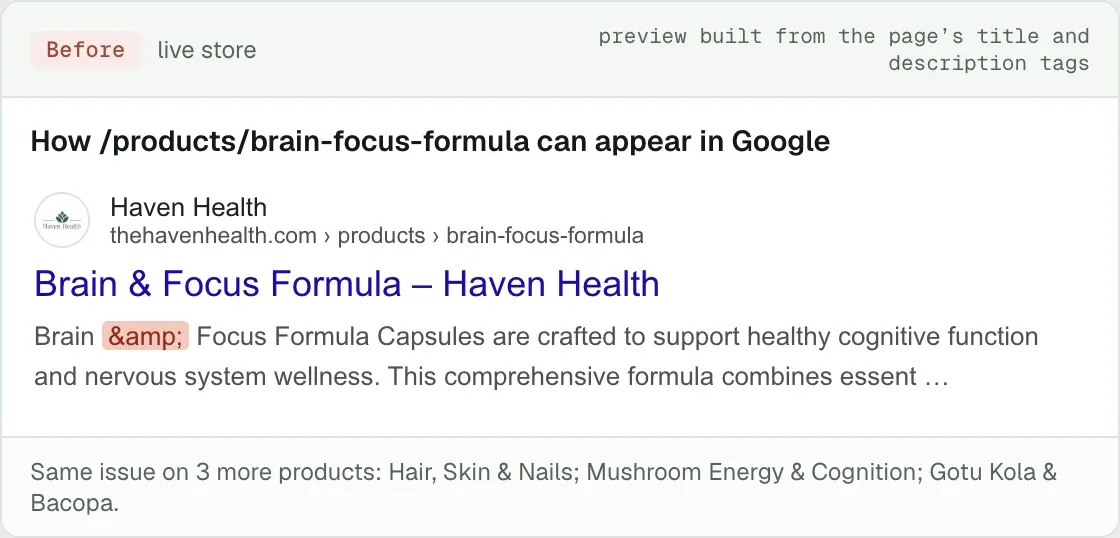
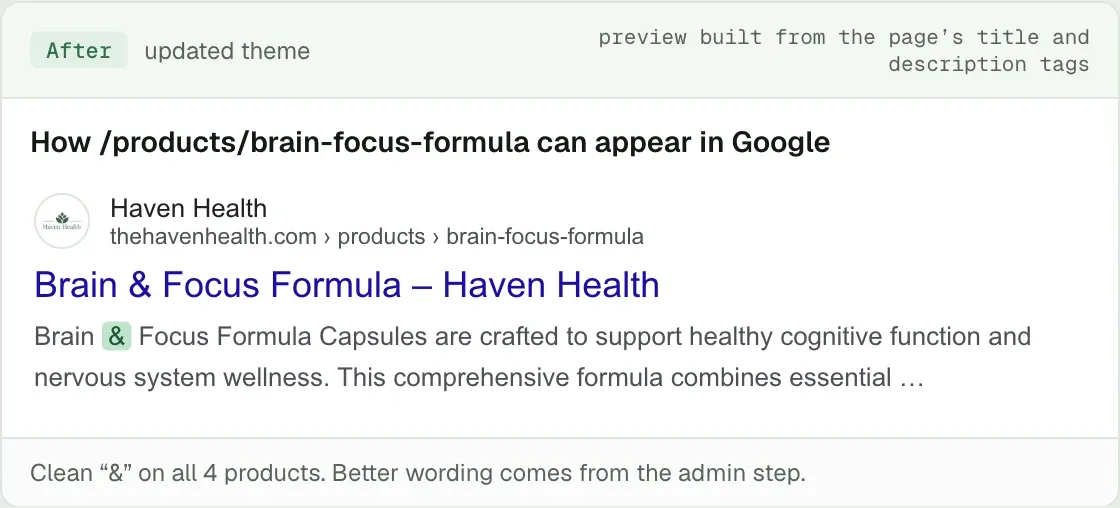
- SEO titles and descriptions for every product and collection.
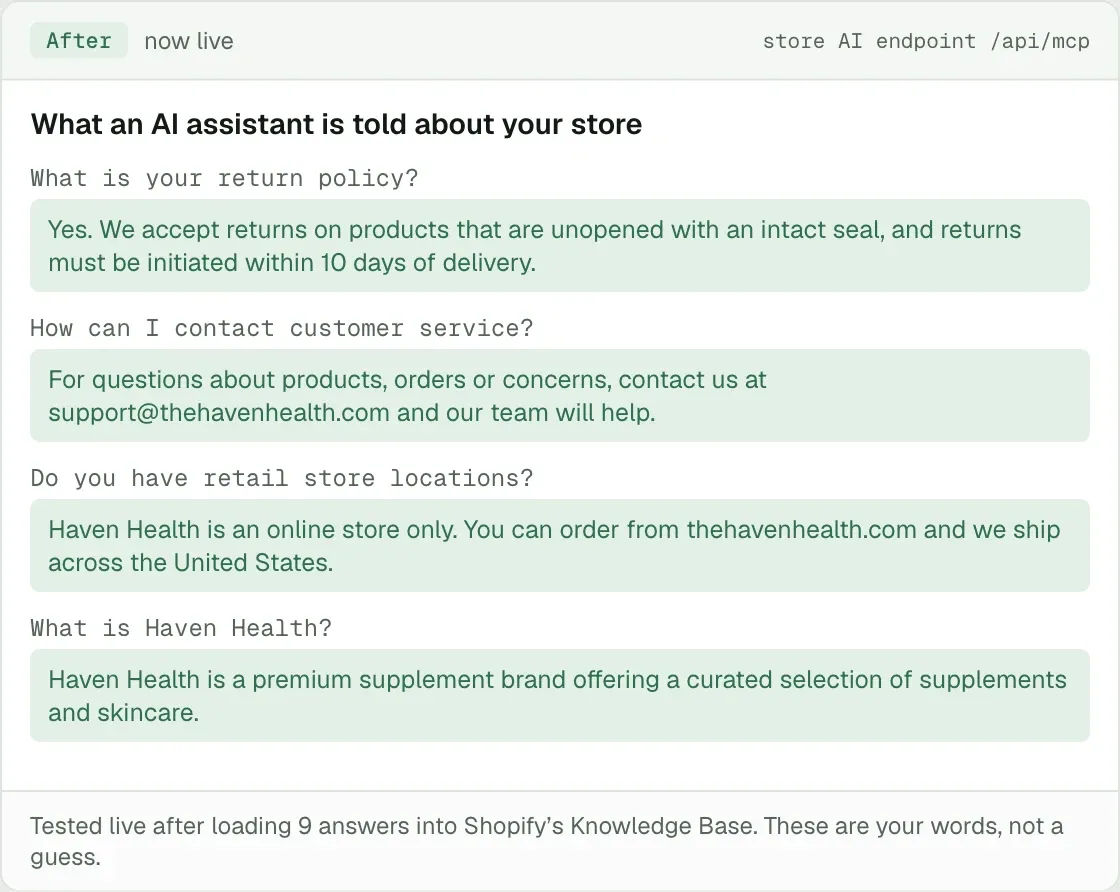
- Nine answers loaded into Shopify’s Knowledge Base, so AI assistants describe the store in the brand’s own words.
- Claims the brand could not back up were removed, with the owner’s agreement.
Testing
The same 31 pages were measured before and after with the same audit. The score went from 47.9 (a D) to 79.9 (a B). All 58 product pages now have valid product data.
Every change has a numbered before and after in the report, 40 pairs in all, delivered with two PDF reports. Two of the pairs are shown on this page.
| What was measured | Result |
|---|---|
| Score across the same 31 pages | 47.9 (D) to 79.9 (B) |
| Product pages with valid product data | 58 of 58 |
| Before and after pairs in the report | 40 |
Result
The store launched on time and was measured afterwards. The owner went on to refer another brand to HFM Dev.
Built with
Liquid, Structured data (JSON-LD), Admin GraphQL API, Shopify Knowledge Base.